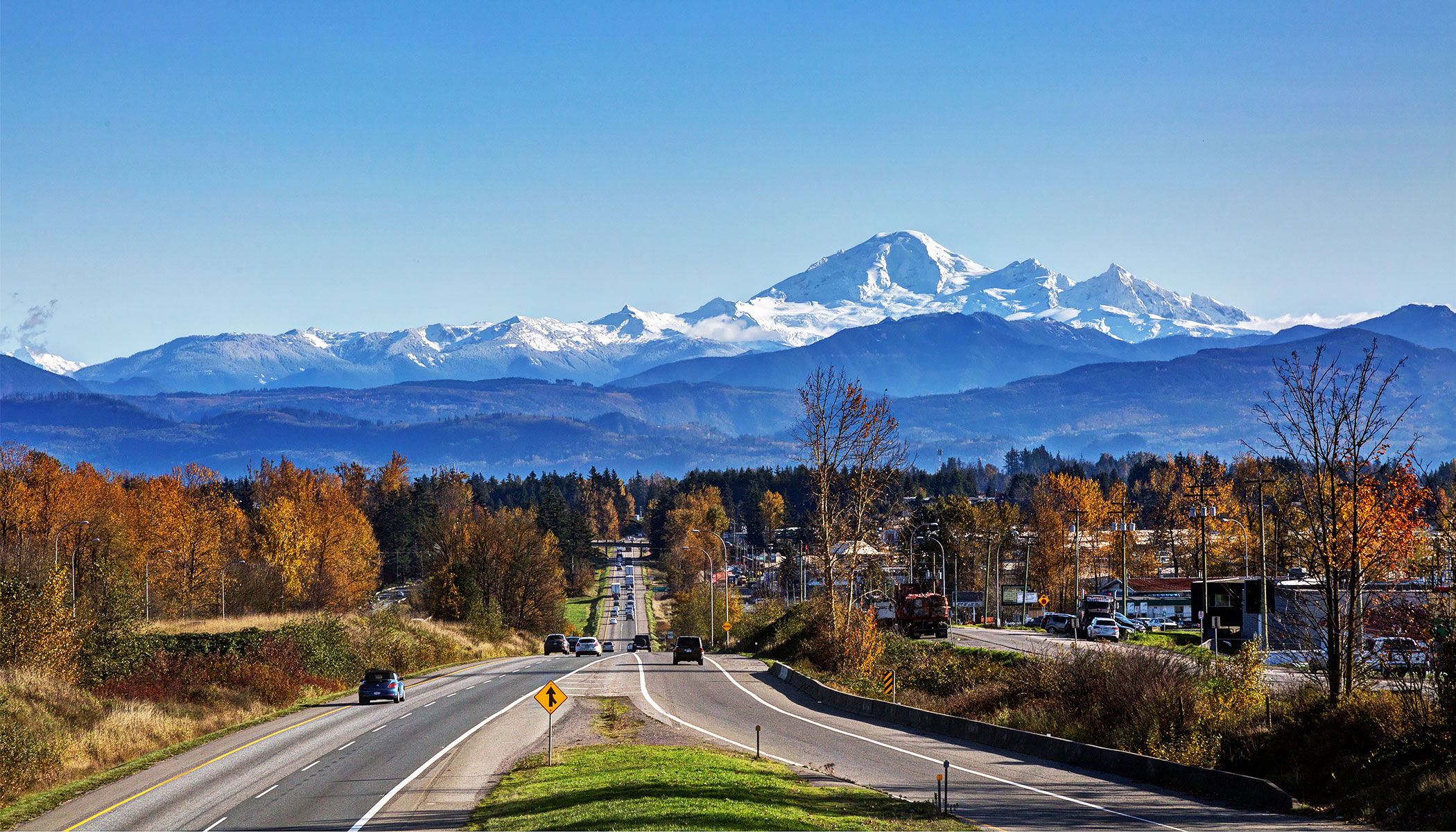

Abbotsford, a city in the country. A Canadian border town tucked just north of Sumas, Washington State. It sits in a dramatic pocket of the Fraser Valley, wrapped by mountain ranges that shape not only its skyline but also its identity. On one side, the Cascade Range rises sharply; on the other, the rolling North Shore mountains of the valley complete the panorama.
And of course, there’s Mount Baker, that iconic giant in the U.S, a view so striking that it has become a selling feature in real estate listings and appraisals. In Abbotsford, a good view isn’t just a perk; it’s part of our culture.
I’ve had the fortune of calling Abbotsford home for more than thirty years.
Living here meant quick trips across the border, cheaper milk and gas from U.S. gas stations and corner stores, and easy access to American airports, a real advantage when you have family spread across the States.
My early memories are filled with farmland drives, and the rhythm of life in a true border community. Entire businesses on the U.S. side grew because of Canadian shoppers, and many farmers still own land that straddles both countries. Zero Avenue, running parallel to Washington State, is a constant reminder of how ridiculously close both the countries are.
But things are changing. The past year has brought some of the most dramatic shifts we’ve seen, and Abbotsford’s position on the 49th parallel is only going to amplify the pressure.
With the U.S. imposition of tariffs, Abbotsford is emerging as one of Canada’s most exposed cities. More than 90% of Abbotsford’s exporters rely primarily on the U.S. market, and local companies are pausing expansion plans, reworking supply chains, and even considering opening U.S. based operations to bypass new trade barriers. The uncertainty is being felt across agriculture, manufacturing, and transportation.
With a diverse population sitting at about 168,000 Abbotsford isn’t just a growing city in the Fraser Valley. It sits at the centre of one of Canada’s most important West Coast transportation corridors. Its location places it directly along British Columbia’s major east–west route and one of the province’s key north–south trade links, connecting Metro Vancouver to the rest of Canada and linking Canadian markets to the United States.
Highway 1 through Abbotsford is undergoing multibillion dollar upgrades to improve goods movement, commuter flow, and regional connectivity. This corridor ties directly into Highway 11 (Sumas Way), a critical Canada–U.S. trade link that serves as a major commercial and passenger gateway between B.C. and Washington State.
Abbotsford is home to major industries that depend on cross-border, national, and international exchange of goods and services. Cascade Aerospace, a specialty aerospace and defence contractor headquartered in the city, focuses on long-term integrated aircraft
support programs for military, government, and commercial clients with the United States Air Force (USAF) being one of its major customers.
The Abbotsford International Airshow isn’t just another summer event; it is recognized as one of Canada’s most iconic and largest annual aviation festivals. Over three days in August, it attracts tens of thousands of spectators who come to watch legendary performers including the snowbirds, blue angels, thunderbirds, and international demo teams. Military and civilian pilots showcase aerobatics, tactical demonstrations, formation flying, and high energy maneuvers that shake the valley floor. More than 350,000 square feet of aircraft; from fighter jets to carbon fiber planes are on display from Canada, the U.S., Britain, France, Italy, Germany, Russia, the Netherlands, Brazil, Chile, and more, all open for tours and photos.
Abbotsford’s berry and lumber industries are two of the economic pillars that define the Fraser Valley. Berries are a major contributor to the city’s agricultural GDP, supporting growers, processors, seasonal labour, cold-storage facilities, and export logistics. Abbotsford Growers Ltd. processes high volumes of blueberries and raspberries, benefiting from the region’s fertile land, rich soil, and ideal climate, making it one of the best berry growing areas in Canada. Local processors ship berries across North America, supported by strong food-safety systems and in house testing labs.
In the lumber sector, Jasco Forest Products has operated in Abbotsford since 1998, specializing in remanufacturing Western Hemlock and Douglas Fir for export primarily to the U.S., but also to Italy, the U.K., Germany, Japan, and across Canada. Reimer Hardwoods’ Abbotsford location serves as its head office and largest facility, with 70,000 square feet of warehouse space for hardwood distribution and millwork supply.
Many Abbotsford lumber companies ship globally, supporting manufacturing jobs, export revenue, and supply chains for construction, millwork, and industrial wood products.
It’s no surprise that Abbotsford is ranked as the 15th most vulnerable region in Canada to U.S. tariffs and the most vulnerable in British Columbia. But the challenges extend beyond trade policy. Geography adds another layer of risk. The Nooksack River in Washington State has a direct and well reported impact on flooding in British Columbia’s Fraser Valley. Its natural overflow path points directly toward Canada, and the former Sumas Lake basin (now Sumas Prairie) forms a bowl-shaped floodplain. During atmospheric river events, Abbotsford receives cross-border spillover that overwhelms drainage systems, flooding farmland and transportation corridors. This has led to two major flooding events just in the past five years, with economic losses reaching into the millions for Abbotsford.
Even though this city in the country is not a major metropolis, it needs to be recognized for its outsized role in continental trade, agriculture, aerospace, and transportation. It is situated on the traditional and ancestral territory of the Semá:th (Sumas), Mathxwí (Matsqui), and Leq’á:mel First Nations.